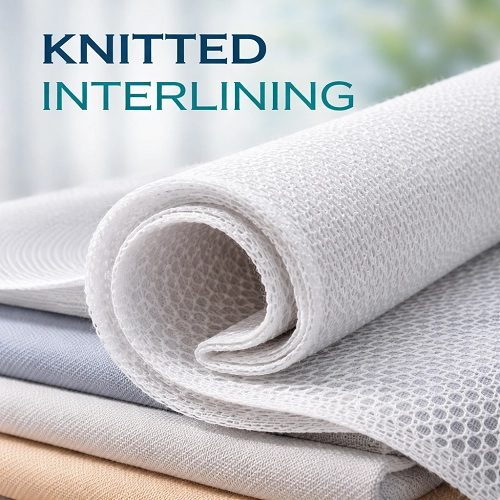
Enhancing Every Garment

Knitted interlining is a type of supportive fabric placed between the outer fabric and lining of a garment to provide structure, shape retention, comfort, and durability. Unlike woven interlinings, knitted interlinings are created through looping yarns, which offers elasticity, softness, and flexibility that enhances garment performance.
At our company, we define knitted interlining not just as a material, but as an engineered component—one that improves garment quality from the inside out.
The demand for garment structure dates back centuries, evolving from plant-based stiffeners and hand-stitched reinforcements to modern technical fabrics.
Knitted interlining emerged as textile technologies advanced in the 20th century, meeting the need for flexibility and comfort that rigid woven interlinings could not deliver.
In the 1960s and 1970s, knitting machinery and synthetic fiber innovation accelerated production capabilities. Knitted interlining began to appear in quality tailoring, sportswear, and performance wear. With enhanced elasticity and breathable qualities, it quickly garnered preference among designers seeking greater comfort without sacrificing structure.
The development of knitted interlining is grounded in a scientific approach to yarn selection, knitting mechanics, and finishing processes:
Knitted interlining is produced on circular or warp knitting machines.
Machine parameters (gauge, pattern, tension) are tailored to the intended performance profile.
This ensures optimal performance and consistency.
Knitted interlining has evolved alongside fashion and performance needs:
Modern knitted interlining represents a new standard in inner garment engineering. We combine innovations in fiber science with precise knitting design to achieve:
Our latest products are engineered for both performance and fashion—balancing structure with mobility.
Knitted interlinings distinguish themselves through a set of valuable attributes:
Enhanced stretch across multiple directions, allowing freer movement and better garment comfort.
Looped knit structure allows air circulation, a major advantage for all-season comfort.
Resilient recovery reduces distortion and maintains garment silhouette over time.
Offers structure without bulk—critical for modern lightweight apparel.
Engineered for excellent dimensional stability and resistance to shrinkage or sagging.
| Specification | Description |
| Weight | Ranges from ultralight to medium, depending on garment needs |
| Thickness | Tailored to application (e.g., collars vs. body panels) |
| Stretch % | Measured in warp and course directions for precise selection |
| Composition | Polyester/nylon/elastane blends for balance of resilience, softness, and stability |
| Finish | Options include fusible adhesives, water-repellent, anti-wrinkle |
Custom specifications are available to meet unique design and performance requirements.
To ensure optimal performance in finished garments:
Knitted interlining is a versatile, performance-enhancing material that brings structure, comfort, and resilience to modern garments. Its evolution reflects the changing demands of apparel design—where mobility and form are equally valued.